AEM Assets: How Adobe's DAM Works in AEM as a Cloud Service
AEM Assets in 2026: Prime and Ultimate editions, Admin View, Assets View and Content Hub, asset microservices, Dynamic Media with OpenAPI, Connected Assets and the Assets APIs.
Rewritten in October 2026 for AEM Assets as a Cloud Service, checked against Adobe's Assets documentation and release notes.
On this page
AEM Assets is the digital asset management (DAM) part of Adobe Experience Manager. It stores images, videos, documents and design files with their metadata, and it delivers them to websites, apps and campaigns. Today it's sold mainly as AEM Assets as a Cloud Service, which Adobe keeps updated continuously. AEM 6.5 and AEM 6.5 LTS still run Assets on premises and on Adobe Managed Services. This guide covers the cloud version and points out where 6.5 differs.
The editions
| Edition | What you get |
|---|---|
| Assets Prime | A lightweight DAM: asset management, search, collaboration, rights management, Content Hub, and connections to Creative Cloud and Experience Cloud. No UI extensions, API-driven automation or custom code, and only a production environment. |
| Assets Ultimate | Everything in Prime, plus customization, API access, extensibility and add-ons such as content automation. |
| Dynamic Media Prime / Ultimate | Add-ons for delivery. Prime covers basic image transformations, optimized delivery and adaptive video streaming. Ultimate adds Smart Crop, Smart Imaging, secure delivery, image presets and the full Dynamic Media solution. |
| Assets Essentials | A lighter edition that comes embedded with Workfront, Adobe Journey Optimizer and Creative Cloud for enterprise. |
Adobe introduced the Prime and Ultimate packaging for Dynamic Media in release 2025.2.0. Content Hub user counts differ by edition: Prime includes 50 Content Hub limited users, Ultimate 250. Adobe doesn't publish prices. The difference between Essentials and the full product is covered in Assets Essentials vs AEM Assets as a Cloud Service.
Three interfaces, one repository
- Admin View is the full DAM interface for librarians and administrators: workflows, integrations, processing profiles, publishing.
- Assets View is a simpler interface for creatives and occasional users, built around search, upload, metadata and sharing. It has a few things Admin View lacks: a personal workspace, folder uploads, image editing through Adobe's embedded editors, and soft delete.
- Content Hub is a portal for distributing approved, on-brand assets to internal teams and partners. Approved assets appear in it automatically.
All three work on the same assets in the same repository. Content Hub needs a production author environment and isn't available on AEM 6.5 or Adobe Managed Services.
Brand Portal, the older way to share assets with partners, is in maintenance mode. Adobe puts new development into Content Hub, and Brand Portal isn't available with the Prime and Ultimate editions. The older options are compared in Brand Portal vs Asset Share Commons vs Dynamic Media.
How upload and processing work
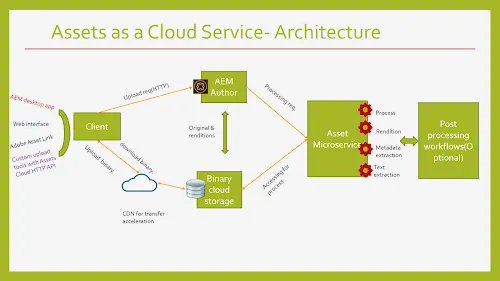
In AEM as a Cloud Service, binaries don't pass through AEM. An upload goes like this:
- The client asks AEM to start an upload and gets back one or more upload URLs.
- The client sends the file straight to cloud storage.
- The client tells AEM the upload is complete.
- AEM sends a processing request to the asset microservices, which read the file from storage, create renditions, extract metadata and text, and report back.
Processing runs outside the AEM server, so a large batch of uploads doesn't slow down authoring. For bulk loads, Admin View can import from Azure Blob Storage and Amazon S3. Assets View adds Google Cloud, Dropbox and OneDrive. For code, Adobe provides the aem-upload Node.js library and an Adobe I/O CLI plugin. Since release 2025.12.0, uploaded files are also scanned for malware.
Processing profiles instead of DAM Update Asset
The biggest change for anyone coming from AEM 6.5: the DAM Update Asset workflow isn't used for processing in the cloud. Processing works on three levels:
- Default processing always runs: thumbnails of 48, 140 and 319 pixels, a 1280-pixel web rendition, and metadata and text extraction.
- Processing profiles add renditions in JPEG, PNG, GIF or WebP, with their own sizes and quality. They are created under Tools > Assets > Processing Profiles and applied to folders.
- Custom profiles call your own application built on the Asset Compute Service, for example to call a Photoshop API.
Steps that used to sit in DAM Update Asset go into post-processing workflows, which start automatically once processing is done. Some things from 6.5 are gone entirely, among them ImageMagick or other command-line steps, FFmpeg transcoding, ZIP extraction and asset ratings. Packages uploaded through Package Manager aren't processed; their assets have to be reprocessed by hand.
On AEM 6.5 and 6.5 LTS, processing still runs in DAM Update Asset, with media handlers and command-line steps. The 6.5-era features are described in AEM 6.5 new features in Assets.
Metadata, Smart Tags and AI search
- Smart Tags are switched on automatically in the cloud. They tag images, videos and text documents, each tag with a confidence score.
- AI-generated metadata writes titles, descriptions and keywords. It arrived in release 2025.5.0 and, since 2025.12.0, no longer needs a separate GenAI contract.
- AI search, a semantic and multilingual search that tolerates typos and synonyms, came to Assets View and Admin View in release 2026.1.0 and to Content Hub in 2026.5.0.
Earlier machine-learning features are listed in machine learning features in AEM.
Delivery: Dynamic Media with OpenAPI
Dynamic Media with OpenAPI, called Next Generation Dynamic Media until recently, delivers approved assets by URL without copying them anywhere. A delivery URL looks like:
https://delivery-p123-e456.adobeaemcloud.com/adobe/assets/{assetId}/as/{seoName}.{format}Parameters on the URL resize, crop, rotate, change quality or format, or apply a smart crop. Images go out as WebP where the browser supports it; videos as HLS or DASH streams. Because the CDN caches responses for ten minutes, a change made in the DAM shows up on every site that uses the asset within about that time. You'll need both an AEM Assets and a Dynamic Media license, and Adobe Support switches the feature on.
The classic, Scene7-based Dynamic Media still exists in the cloud, as part of Dynamic Media Ultimate. The old Dynamic Media Classic integration and Hybrid mode don't.
Using assets on AEM Sites: Connected Assets and remote assets
Large organizations often run the DAM and the websites as separate AEM deployments. There are two ways to connect them:
- Connected Assets lets Sites authors search the remote DAM from the page editor and drop assets into Image and Download components. Each asset used is copied into the Sites repository as a read-only asset under
/content/dam/connectedassets/. The DAM can be on AEM as a Cloud Service or on AEM 6.5 on Adobe Managed Services. It's still supported, but it doesn't handle video and is limited to four Sites instances per DAM. - Remote assets through Dynamic Media with OpenAPI is what Adobe now recommends. Nothing is copied: the Image component references the approved asset and delivers it by URL. It supports every format, video included, and has no limit on the number of Sites instances. It needs the DAM on AEM as a Cloud Service, Sites on AEM as a Cloud Service or AEM 6.5 SP18 or later, and Core Components 2.23.2 or later. In the Image dialog, authors pick Remote instead of Local.
APIs
- Assets Author API (OpenAPI, under
/adobe/assetson the author service): search, metadata, renditions, relations, import from a URL, and events such as "processing completed". It is set up in the Adobe Developer Console. Environments created before November 2024 may need to be modernized first. - Assets HTTP API (
/api/assets): the older REST API for folders, assets, metadata and renditions. In the cloud, its binary upload calls and its Content Fragment support are deprecated. - Direct binary upload:
initiateUpload.json, then a PUT to cloud storage, then a call tocompleteURI, as described above. - Asset Selector and the newer Content Advisor: ready-made pickers that let another application browse and choose assets from AEM. Content Advisor came to AEM Sites in release 2026.3.0.
AEM Assets as a Cloud Service vs AEM 6.5
| AEM 6.5 / 6.5 LTS | AEM as a Cloud Service | |
|---|---|---|
| Processing | DAM Update Asset workflow on the AEM server | Asset microservices, processing profiles, post-processing workflows |
| Upload | Binaries go through AEM | Direct binary upload to cloud storage |
| Interfaces | Assets console | Admin View, Assets View, Content Hub |
| Sharing with partners | Brand Portal | Content Hub |
| Smart Tags | Configured separately | On by default |
| Updates | Service packs | Continuous, by Adobe |
The wider picture of what changes in the cloud is in our AEM as a Cloud Service guide and the FAQ on AEM as a Cloud Service.
Common questions
What is the difference between Assets Prime and Assets Ultimate?
Prime is the lighter DAM without customization, API-driven automation or custom code, and with a production environment only. Ultimate adds customization, API access and extensibility.
Is Connected Assets deprecated?
No deprecation has been announced, and it is still documented. Adobe now recommends remote assets through Dynamic Media with OpenAPI for new setups.
Can I still use the DAM Update Asset workflow in the cloud?
Not for processing. Use processing profiles for renditions and post-processing workflows for your own steps.
Is Brand Portal going away?
It's in maintenance mode and isn't sold with Prime or Ultimate. Content Hub is where Adobe develops partner and brand distribution now.
More in Assets and Dynamic Media
- Assets Essentials vs AEM Assets as a Cloud Service
What Adobe Experience Manager Assets Essentials is, how it differs from AEM Assets as a Cloud Service, and which one suits which customer.
- AEM 6.5 New Features in Assets
What AEM 6.5 added to Assets: Adobe Asset Link, the desktop app update, Adobe Stock integration, remote DAM, Brand Portal, visual search and Dynamic Media with Sensei.
- Brand Portal vs Asset Share Commons vs Dynamic Media
The difference between Adobe Brand Portal, Asset Share Commons and Dynamic Media: what each one does, licensing, customization, and which to choose.
- AEM with Brand Portal: Uses, Features and Integration
What Adobe Brand Portal is for, its asset distribution and asset sourcing features, how it compares with Asset Share Commons and Dynamic Media, and integrating it with AEM.
- Media Handlers with AEM Workflows to Process Assets
What AEM media handlers are, how they work with workflows to extract metadata and create thumbnails, and where to enable or disable them.