AEM Assets as a Cloud Service, part of the AEM as a Cloud Service platform, provides digital asset management — storage, online metadata management, versioning, upload and download — with these extended capabilities:
- Built on asset microservices for asset ingestion and processing
- Smart capabilities such as AI/ML
- Highly scalable
- Always current
- Always available
- Automatically scaled, deployed and monitored
In older AEM versions every asset operation ran on the author instance, which consumed considerable CPU, memory and I/O. Asset processing and storage demanded resources that caused performance problems for authoring and for end users browsing the site.
High-level architecture
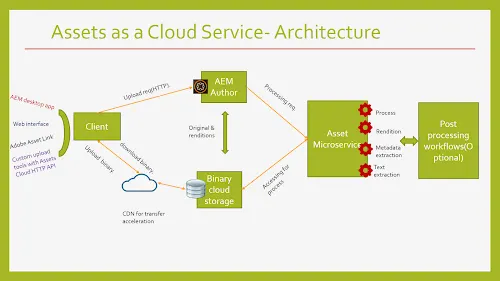
The steps, in order:
- The client sends an upload request, then uploads the binary directly to cloud storage.
- When the direct upload completes, the client notifies AEM.
- AEM sends a processing request to the asset microservices.
- The asset microservices process the asset according to the rendition request from AEM. They read the binary from cloud storage and write the processed renditions back to it.
- The asset microservices notify AEM that the renditions are available.
Assets as a Cloud Service vs on-premise asset upload
- Upload and download. The cloud service uses direct binary access; previously assets were uploaded to the author instance for processing.
- Processing. The cloud service uses asset microservices outside AEM; older versions processed everything inside AEM.
- DAM Update Asset. Not available in the cloud service — the asset microservices cover most default processing (renditions, metadata extraction, text extraction for indexing). Older AEM ran the DAM Update Asset workflow by default.
- Customization. The cloud service offers post-processing workflows for work that processing profiles cannot do. Older AEM had default plus custom workflow steps, all running inside AEM.
- Interface. The standard upload interface in the cloud service is the Touch UI; older versions also had the Classic UI.
- APIs. Only the new upload APIs are supported. The older AEM Assets HTTP API upload (AEM 6.5) and the AssetManager Java API upload are deprecated.
Advantages of the cloud approach
- Uploaded binaries no longer pass through AEM, which only coordinates the upload with the binary cloud storage configured for the deployment. Clients get direct access to the binaries, which reduces network load and duplicate storage.
- Binary storage sits behind a CDN, which brings the upload endpoint closer to the client and improves upload performance, especially for distributed teams.
- Asset uploads scale better and perform better.
Ways to upload assets
Through the web interface, Adobe Asset Link, the AEM desktop app, or custom applications that use the new HTTP API.
Post-processing workflows
When an asset needs processing the microservices do not provide — for example, a rendition that requires an integration with another application — post-processing workflows can be added to the configuration.
Once configured, AEM runs post-processing workflows automatically after the microservices finish. There is no need to add workflow launchers to trigger them.
Typical uses:
- Custom workflow steps to process assets
- Additional processing by external services
- Integrations that add metadata or properties to assets from external systems
Creating a post-processing workflow
- Create one or more workflow models — regular AEM workflow models.
- Add the workflow steps you need to these models.
- Add the DAM Update Asset Workflow Completed process step at the end, to tell AEM that processing is done.
- Create a configuration for the Custom Workflow Runner Service (an OSGi service configuration). It runs a post-processing workflow model either by path (folder location) or by regular expression.
Supported file formats
| Adobe formats | AI, COLLAGE, DN, IDEAS, INDD, INDT, PDF, PROTO, PSB, PSD, XD |
| Image formats | BMP, EPS, GIF, JPEG, PNG, SVG, TIFF |
| Image formats in Dynamic Media | PNG, GIF, TIFF, JPEG, BMP, PSD, EPS, PICT |
| 3D formats | DN, GLB, glTF, OBJ, STL, USDZ |
| Camera raw formats | 3FR, ARW, CR2, CR3, CRW, DCR, DNG, ERF, FFF, GPR, IIQ, KDC, MEF, MFW, MOS, MRW, NEF, NRW, ORF, PEF, RAF, RAW, RW2, RWL, SRF, SRW, X3F |
| Document formats | PDF, DOCX, DOC, PPTX, PPT, XLSX, XLS, ODF, OFG, ODM, ODP, ODS, ODT, EPUB, HTML, PS, RTF, TXT, XML |
| Document formats in Dynamic Media | AI, PDF, INDD |
| Video formats | 3G2, 3GP, AVI, DIVX, F4V, FLV, M2T, M2TS, M2V, M4V, MKV, MOV, MP4, MPEG, MPG, MTS, OGV, QT, R3D, SWF, WEBM, WMV |
| Video formats in Dynamic Media for transcoding | MP4, MOV, QT, FLV, F4V, WMV, MPG, VOB, M2V, MP2, M4V, AVI, WebM, OGV, OGG, MXF, MTS, MKV, R3D, RM, RAM, FLAC, MJ2 |
| Audio formats | AIF, ASF, M4A, MP3, WAV, WMA |
Related: FAQ on AEM as a Cloud Service and Assets Essentials vs AEM Assets as a Cloud Service.