Distributed deployment is becoming common, and agile DevOps depends heavily on containerized deployment. It started with microservices and keeps spreading.
The advantage of running AEM with Docker
Docker speeds up AEM deployments. The latest production environment can be imported to a local file path as images. If a test environment crashes, it can be replaced or repaired from those images, and the images can be exported to any Docker system to add instances on demand.
What is Docker?
Docker runs applications in an isolated environment with its own CPU, memory and network stack.
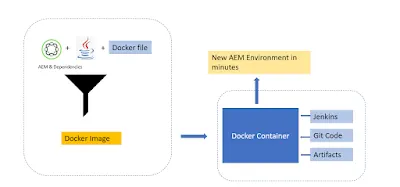
A Dockerfile describes how to build an image from AEM and its dependencies. The image is then deployed to a new environment where code deployments are configured, so a new environment is up and ready in a few minutes.
Are AEM and Docker a good pair?
Some argue that AEM is stateful, since its repository holds the content. Even so, a brand-new AEM environment can be made available quickly, and Adobe has been working towards container-based AEM delivery — which is how AEM as a Cloud Service runs today.
What it means for AEM admins and developers
Because containers are now the standard way to deploy, AEM admins and developers should build a good understanding of Docker and containerization.